BEFRIENDING STRESS As a Path Home to Ourselves WEEK 2/6 What Exactly IS STRESS?
Mar 09, 2026
Welcome to Week 2!
A 6 Week Series on BEFRIENDING STRESS As a Path Home to Ourselves.
In the first week of the Series we talked about how the BIGGEST BLOCK to doing the work we feel called to step into, is the comparison trap. Struggling to believe that our unique path, our process, our strength, our truth, our message, isn't enough.
My invitation is to step off the comparison track and onto the Conscious Curriculum of humility in remembering you were put on this planet to heal, and to overcome YOUR UNIQUE journey, overcoming the part of you that you are inspired to grow into.
You are EXACTLY where you are supposed to be, on your own unique evolutionary, growth and soul journey.
This is a permission slip to be whole and complete, broken and a work in progress.
Choosing your own pace, in your own time. On your own path, following your own process.
Feel inspired to grow through, and gradually more into YOUR WORK. Trust your way.
I am with you. I am also on my own conscious curriculum.
This is permission to listen to your life.
The crux, the fear, the repeating pattern, the constant you know you need to look at. Lean into the ONE obstacle this phase of your life, is calling you to overcome.
Using your stress, your resistance, your current conflict, your tension, your tightness, as a trailhead towards your truth.
Throughout this 6 week Series I am inviting you to step off the comparison track and choose to enter onto your own path of the Conscious Curriculum.
We will be focusing on more deeply UNDERSTANDING your unique STRESS RESPONSE as a way of moving towards greater Stress Resilience & Self Leadership in the areas of your life that are most stubborn.
We are going to explore different ways you can meet, tend to, and befriend how STRESS (or the sympathetic Fear Response) is the most common block to you actually slowing down, and acting into a place of inner alignment and personal power towards your most meaningful and value aligned goals.
In the first week of the series, we explored how Stressors, are experienced in a myriad of ways not as an isolated and individual issue, but a modern day collective struggle across many different contexts and arenas of life.
This series is in service of growing awareness. By committing to the ongoing practice of the 8 L's of Life Leadership principles shared throughout the 6 week series, I am trusting you will feel significantly more empowered to meet the stressors in your life from a place of curiosity and compassion, inviting in more Stress Resilience, capacity, and overall wellbeing in meeting the challenges and growth areas of your life.
If you want to revisit and start from the beginning, find the Week 1 of the series HERE.
6 Week BEFRIENDING STRESS as a Path Home to Ourselves OVERVIEW:
Week 1 |
WHY CARE ABOUT STRESS?
Week 2 |
WHAT EXACTLY IS STRESS?
WHAT IS A STRESSOR?
WHAT IS ALLOSTATIC LOAD & TOO MUCH STRESS?
WHAT IS THE ALLOSTATIC LOAD FORMULA?
Week 3 |
WHAT IS STRESS IN THE MINDBODY NERVOUS SYSTEM?
Week 4 |
WHAT IS STRESS IN THOUGHTS, THINKING, MIND, & EGO?
Week 5 |
WHAT IS STRESS IN BEHAVIOUR?
Week 6 |
WHERE DO WE GO FROM HERE?
8 L's of LIFE LEADERSHIP as A TOOLKIT for STRESS RESILIENCE.
TRANSFORMING DISTRESS into manageable and PURPOSE INSPIRED EUSTRESS.
Welcome to Week 2!
Healthy Reminder:
Before we start, I want to recognize and honour that talking about stress in itself, can spark a stress response and potential fear, so my invitation is to enter this journey slowly from a place of genuine curiosity, and self compassion as a way of increasing AWARENESS.
Initially "parts" may feel overwhelmed, learning about the experience of stress. So please tend to your own system, and needs as you feel necessary. Return to the Blog when you feel you are in a regulated and balanced place and perspective.
AWARENESS is the FIRST step in giving us back our AUTONOMY to have a felt sense of CHOICE, and control over how to be with our Stress Response in new more healthy, and helpful ways.
Let's get started in Week 2.
What EXACTLY is STRESS!?
We can’t talk about stress without addressing one key DISTINCTION.
There is a fundamental difference between a STRESSOR (A potential discomfort, pain, hurt, or wound, that contributes to a loss of ones core needs.)
and,
the subjective individual's learned STRESS RESPONSE (Fear response, or Internal Resistance) while being exposed to it.
It is commonly seen where we blend the cause (the stressor), and the individuals unique learned response (stress response) as one and of the same.
But if we are to find the healing benefit of this work. We must stay curious of how each individual has a nervous system that responds to the same stressor in uniquely different ways.
Often times based on their past learning, conditioning, and felt capacity to deal with the perceived threat to ones core needs.
It's important to remember this is not an opportunity for comparison, but rather an invitation to lean into learning more about how your UNIQUE NERVOUS SYSTEM, has learned to cope with potential discomfort and pain.
One of the reasons this concept can be difficult to comprehend is the very job of the ego/self protective mind, is to blur physical reality (Stressor), with subjective reality (Stress response) to try and ensure we see the external reality as absolute truth, rather than relative truth, in attempts to ensure we are motivated towards avoiding pain and returning to safety.
For now we are not going to overly concern ourselves with this difference, but later in the series we will learn how important this differentiation is.
A large part of, and benefit to awareness practice is noticing how many different, personal, unique, and alternative ways there are for us to meet, and cope with potential discomforts and pains.
Why some develop post traumatic stress growth and resilience through times of great adversity, while others feel overwhelmed and eventually feel defeated by outside challenges, and difficult circumstances.
We’ll see later is this series how practicing awareness develops a GAP for greater access to choice, attitude, and subjective meaning making, which is a huge pivot point opportunity in how be meet our stressors, and with time develop a deeper sense of stress resilience towards our life's challenges.
Let's explore the DEFINITIONS, in efforts to gain a deeper understanding of these two words:
STRESSOR
&
STRESS
WHAT IS A STRESSOR/ PAIN?
To a physiologist, a STRESSOR/PAIN means any stimuli, situation, or experience (REAL OR PERCEIVED) that threatens, risks, or poses danger to the continued stability / homeostasis of the body and its functions.
Expanded it is any obstacle, block, inhibition to one attaining and retaining their biological core needs being met.
Finally, a stressor is any unpleasant, uncomfortable, painful, physical or emotional sensory sensation, that pulls an individual / organism away from it’s core needs, demanding a stress response.
A chemical, biological agent, environmental condition, external stimulus, or an event that contributes to the internal resistance or stress response within an organism.
Some relatable examples of Stressors may include:
A stressor could be physical discomfort or pain, in the case of a cut, wound/injury, or cold weather.
A stressor could be traffic in the way of a goal of getting home for dinner.
A stressor could be a tax or work deadline demanding over exertion of current energy, and mental resources.
A stressor could be an unpredictable change in environment; or an inconsistency between expectations and outcomes creating mental pressure to respond/adapt differently.
A stressor may also come from relationship conflicts to ones emotional needs, or emotional pain, in the case of loss and heartbreak.
WHAT IS STRESS?
Let's Start by exploring Stressors and Stress as a concept relevant in many different fields of science, and then in upcoming weeks narrow it in to how Stress shows up in various ways in the human experience.
Week 2 | Stress Through the lens of Continuum Mechanics, Physics, and Engineering
Week 3 | Stress Through the lens of the Human Body
Week 4 | Stress through the lens of the Thinking Mind/Ego
Week 5 | Stress through the lens of Human Behaviour
Stress Through the lens of Continuum Mechanics, Physics, and engineering
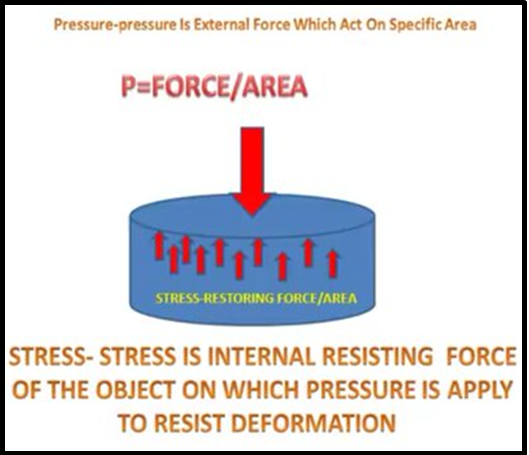
Stress is a physical quantity that describes FORCES present during Deformation.
In it's most basic form, STRESS can be understood as one/ or more set of vector forces of Internal Resistance against an opposing STRESSOR (Pressure, or demand), in efforts to resist deformation.
Starting with Force.
In the Context of Mechanics..
Force = Mass x Acceleration
Force is a push or pull that changes an object's motion/acceleration, or shape, requiring both magnitude (how much) and direction.
For example, an object being pulled apart, such as a stretched elastic band, is subject to tensile force/stress and may undergo elongation.
As humans, we may relate to this experience in our day to day to life, trying to juggle too many life commitments, we feel like we are literally getting stretched in too many directions at once, a forced expansion.
An object being pushed together, such as a crumpled pop can, is subject to compressive force/stress and may undergo shortening.
This could be relatable in our human social circles where one group is over dominant, suppressing or silencing the expression, or voice of others. It feels like a literal shrinking in the body, or forced contraction.
Now we can expand to understand Stress/Pressure:
Stress is measured as Pressure, how a particular Directional Force is displaced against an Area.
The common metric to measure stress, tensile strength, or pressure is the SI unit Pascal (Pa) or newtons per square meter (N/m2).
The Pascal is a fundamental unit for quantifying force distributed over an area.
Measurements commonly seen in atmospheric pressure (often in hPa), tire pressure (kPa), or the strength/stiffness of materials.
In consideration of Stress, we must consider not only the magnitude of incoming Force,
but ALSO the surface area, or availability of a counter force, resistance, or set of resources to cope with the incoming force, altering the total experienced Pressure.
This can be comparable in our human experience of incoming external (worldly), or internal (mental conflict) forces being applied against an internal STRESS RESPONSE, working to maintain a state of homeostasis/ balance, move towards meeting our core needs, goals, and desires, and/or preventing from losing them.
The greater the incoming force and the smaller the cross-sectional area of the body (or available resources) on which it acts, the greater the subjective experience of Internal Stress.
The smaller the incoming force and the greater the cross-sectional area of the body (or available resources) on which it acts, the lower the subjective experience of internal Stress.
A helpful formula:
STRESSOR (DEMAND) - AVAILABLE RESOURCES = STRESS (Internal Resistance)
STRESSORS (Incoming Demand)
can be synonymous with any External FORCE/S being applied against an individual/human beings state of homeostasis/ balance and core needs.
In it’s broadast form this includes, any physical or emotional PAIN, DISCOMFORT, LOSS OF A CORE NEED that an individual does not want to feel and experience.
( - ) Minus
AVAILABLE RESOURCES
Any access to a physical, psychological resource, or strategy that can help us cope with the perceived Stressor.
Physical resources (Money, Equipment, Tools, Materials, Helping Hands, Extra labour, Supporting community)
Psychological resources (Emotional regulation skills, Coping skills, Emotional Support network, family, friends)
=
STRESS (Internal Resistance)
Subjective Internal RESISTANCE, counter force per unit area within a body, required to prevent the move/change/deformation of something.
Resistance is a specific type of force that opposes motion, like friction or air resistance (drag), which slows objects down.
For instance, a push (force) starts a box moving, but friction (resistance) pushes back against it.
We most likely wouldn't ask our 89 year old grandmother to carry a box of records up the stairs, as the demand is disproportionate to the available strength and resources. Unless Grandma's on P90x Program!
We commonly wouldn't start a new exercise routine picking up a 300lb Barbell, as the demand is greater than the muscle fibres available resources to handle them without sustaining injury.

ALLOSTATIC LOAD (Accumulation of Internal Resistance)
A buildup, or accumulation of friction or Resistance in the case of Prolonged or Chronic Stress leads to what is called our total Allostatic load.
The “effort / energy” you are expending/exhausting to resist the stressors.
The “weight / burden” you are carrying to maintain homeostasis and balance.
The Cumulative physiological cost of the body's constant adaptation to ongoing stress. In the case of Chronic Stress, this process involves changes in stress hormones, metabolism, blood pressure, digestive, reproductive and immune function, as well as other organ systems over time, which can lead to long-term health problems.
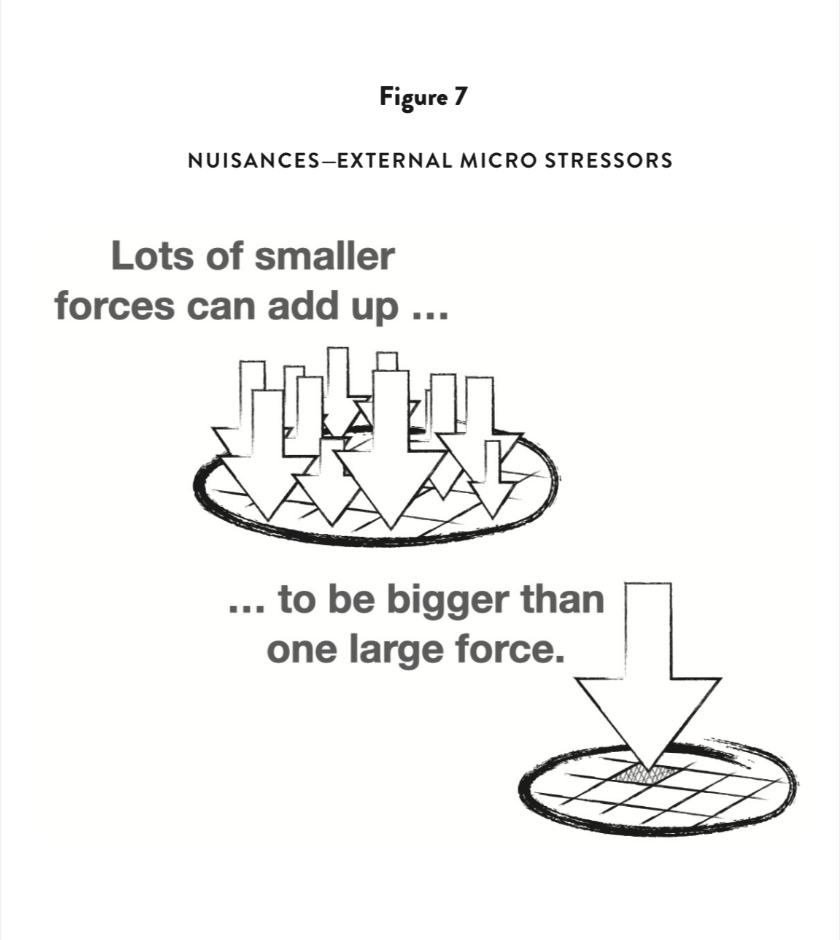
Adopted from Mo Gawdat's book Unstressable, a simple formula for Allostatic Load could look like:
Allostatic Load (Internal Stress) Formula
Number (#) of External & Internal stressors/challenges/pressures
x
Intensity of each stressor
x
Duration of time each stressor lasts
x
Frequency of how often the stressor repeats
___________
=
Net Force of all Stressors or TOTAL ALLOSTATIC LOAD
It's important to remember stress in it's healthy form is what helps us grow, and adapt, evolve, and get stronger as individuals and as a collective.
Similar to why individuals choose to weight/resistance train in the gym. Stress in it's balanced form is healthy, and provides a meaningful challenge.
What we are trying to balance, and prevent is not temporary stress, but rather chronic, imbalanced, or unmanaged stress that leads to premature wear and tear, and/or breakdown.
WEAR & TEAR (STRAIN, FATIGUE, & EXHAUSTION) & BREAKDOWN
Most breakdowns are not caused by catastrophic mishaps, but rather a series of lack of maintenance, attention, care and upkeep, in which eventually cause some components to wear down and start to prematurely fail.

Wear & Tear
Prolonged Stress (Internal Resistance) and excess Allostatic Load, leads to the experience of a
“strain, fatigue, exhaustion” phase in the stress cycle.
Eventually, wear and tear, or even breakdown of the equipment, machine, or human body is likely to occur.
Breakdown or Injury
When the external pressure, demand, or forces surpass (in intensity, duration, or repetition), the materials, equipment, or individuals TOLERANCE, or CAPACITY to handle it, something has to give.
Stiff, and rigid materials or objects will rupture.
Machines, and equipment will break down and experience one or more component failures.
The human body starts showing signs of fragility, sickness, illness, or disease. Organ Systems experience dysregulation, or cells start malfunctioning and breaking down.
A permanent change of shape of an object will occur.
Luckily we have an inborn saving grace!
STRESS TOLERANCE / RESILIENCE
Most materials have a degree of elasticity/ flexibility / adaptability, to bend, and mend under stress, but then return to original shape.
The material/ bodies inherent ability to withstand the external stress without breaking or deforming permanently could be called CAPACITY, TOLERANCE, or Elastic limit.
In the context of Human Beings, the MINDBODY Nervous system’s ability to physically and emotionally be flexible, malleable, and adaptable, to these external STRESSORS (Forces, and Pressures) can be referred to as Stress Resilience.
Stress resilience is a learned, practicable, and trainable skill.
Individuals from all backgrounds, and demographics experience various levels of STRESSORS. And yet, how we learn to cope, adapt, work with, and flow with our stress response, determines how much subjective INTERNAL STRESS we experience.
We may not have complete control over all of our external forces and stressors. But we can remember, we have a much greater influence, and control than we are often aware of, and give ourselves credit for:
Which external stressors we choose to face (Eliminate, Change, Accept/Let go of)?
How we displace, spread out, or share our external stressors/forces, across our access to various resources?
How we choose to internally meet and feel resistance/friction towards incoming forces, that we feel necessary to manage, handle, and cope with?
Growing our awareness, attunement, and understanding of how stress shows up in us on a physiological, psychological/emotional, and behavioural level, combined with growing a toolkit of stress resilience skills, I feel will significantly improve our agency and ability to meet and cope with various stressors across our life.
Throughout this 6 Week Series we are going to JOURNEY TOGETHER to explore STRESS in GRANULAR DETAIL.
All with the intention of not pushing away our DISTRESS, but inviting it in, understanding it, befriending it, and being in relationship to it in a new ways. Ways in which we can balance it, or even transform it into EUSTRESS as a source of meaning, and purpose in a personally empowering way.
EXERCISE | Self Reflections - Stressor vs Stress Response
Finding our Stress Response Internally in the body.
Through a lens of compassionate curiosity.
I welcome you in whichever journalling format works for your parts..
1. Using 1 of the 3 areas of life you noticed an experience of stress around from last week's reflection and journaling.
Notice if you can differentiate between the Stressor & the Stress response (Internal Resistance) you are experiencing in your body.
It may help to temporarily re visualize the stressful experience, to slightly blend with the parts, and feel it become slightly activated in our body.
Note: This is a practice experience, intended to support you in moving towards deeper understanding of your unique nervous system. If at any point it feels too much, or too overwhelming, I invite you to tend to your system, and return to the exercise when it feels more balanced.
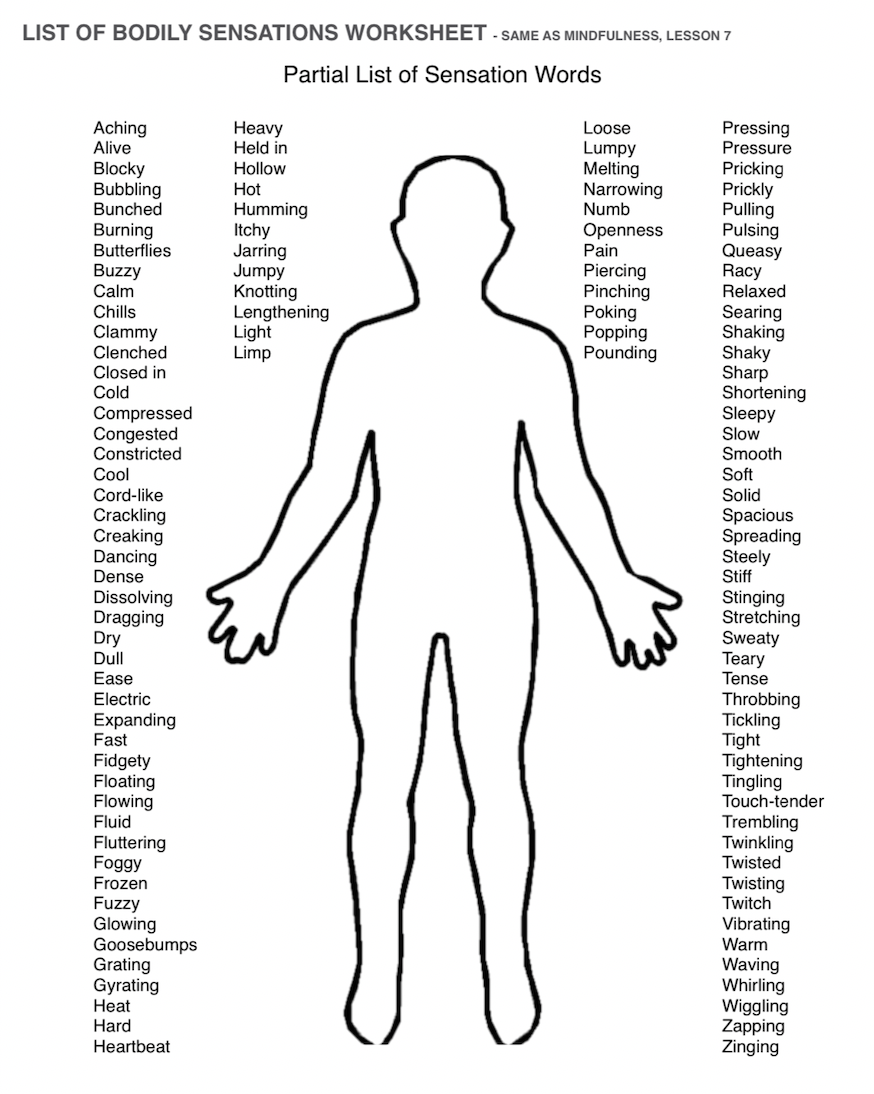
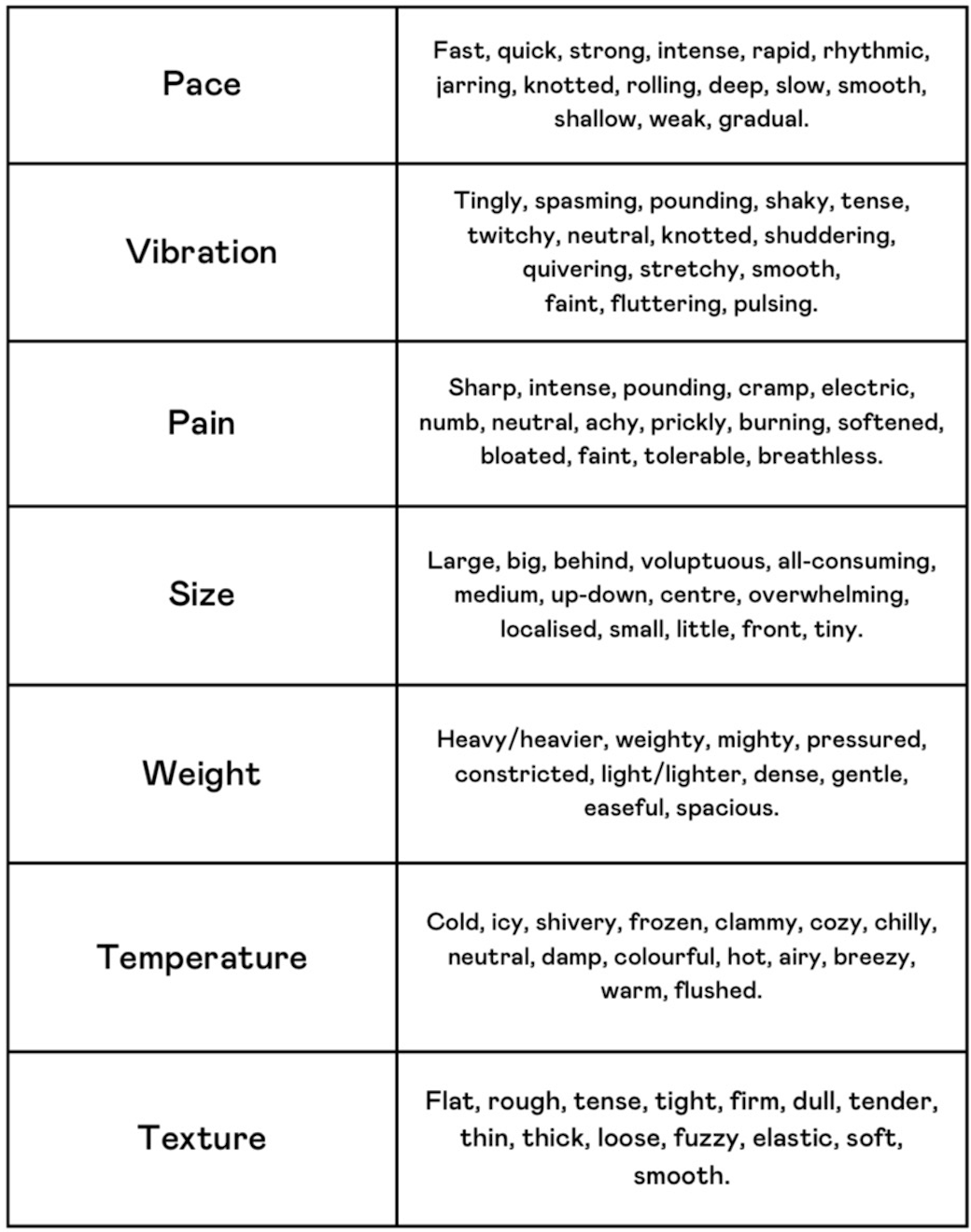
This practice is an introduction to what is called Interoception, or the internal Somatic (body) Awareness, and emotional Attunement towards what is going on inside of us.
For 1 of the 3 Stressful experiences you recorded last week; map out what internal experience you were having during this activating experience.
I welcome you to use and draw on the Body Map and Sensation Lists as guides to help you deepen into your felt connection to your experience.
2. Journalling any Shifts
Now that you have taken a moment to notice any internal sensations.
I invite you to stay curious in how these energies are responding as you shift your awareness, and curious attention towards them.
Journal the experience of how the internal experience alters in any way with your non judgemental awareness.
Congratulations! You made it to the end of Week 2.
If you are curious to learn what is possible in deepening your connection with stressed or over protective parts and what they may be struggling with. I welcome and encourage you to Schedule a 1on1 Discovery Call. We can hear from your parts and explore together in what they may be wanting support in.
Join Me Next Week!
For Week 3 of the Series BEFRIENDING STRESS As a Path Home to Ourselves.
Where we will explore.. WHAT is STRESS in the Human body?!
Find a link to Week 3 Here.
Wishing you a compassionate, and regulated week.
Thoughtfully,
Greg