BEFRIENDING STRESS As a Path Home to Ourselves WEEK 5/6 - What is Stress in HUMAN BEHAVIOUR?
Apr 20, 2026
Welcome to Week 5!
A 6 Week Series on BEFRIENDING STRESS As a Path Home to Ourselves.
Throughout this 6 week Series I am inviting you to step off the comparison track and choose to enter into your own path of the Conscious Curriculum, in service of your healing and growth.
We will be focusing on more deeply understanding your unique Stress Response as a way of moving towards greater Stress Resilience & Self Leadership in the areas of your life that are most stubborn.
We are going to explore different ways you can meet, tend to, and befriend how Stress (or the sympathetic Fear Response) is the most common block to you actually slowing down, and acting into a place of inner alignment and personal power towards your most meaningful and value aligned goals.
In Week 1 we explored some of the most common blocks and how comparison can get us stuck before we even allow ourselves to start to listen, and learn from our stress response.
We also learned WHY stress is prevalent topic to draw our attention to in modern day life, across cultures and varying demographics.
In Week 2, we learned about stress on a fundamental level and how it functions in Physics, Mechanics, and Engineering. Including the impacts of excess stress, wear and tear, and breakdown.
In Week 3, we explored Stress in the Human Body. A two part exploration into the History of Stress Research, and how Stress shows up in the Human Body. Meeting the Stress Response both in it's balanced state, and in Pt. 2, the impacts on our bodies when stress becomes Chronic.
Week 4, we dove into how Stress can be influenced by our thinking mind, learned beliefs, and unique perceptions, and perspectives of situations. We also touched on how childhood pains can distort our mental maps of how we see the world.
If you want to revisit any of the prior series blogs, find the link to the beginning of the series HERE.
6 Week BEFRIENDING STRESS as a Path Home to Ourselves OVERVIEW:
Week 1 |
WHY CARE ABOUT STRESS?
Week 2 |
WHAT EXACTLY IS STRESS?
Week 3 |
Part 1
FOUNDING EXPERTS OF STRESS RESEARCH
WHAT IS HEALTHY STRESS RESPONSE IN THE HUMAN MINDBODY NERVOUS SYSTEM?
Part 2
WHAT IS UNHEALTHY CHRONIC STRESS IN THE HUMAN BODY?
Week 4 |
WHAT IS STRESS IN THINKING, BELIEFS, MIND, & EGO?
Week 5 |
WHAT IS STRESS IN HUMAN BEHAVIOUR?
Week 6 |
WHERE DO WE GO FROM HERE?
8 L's of LIFE LEADERSHIP as A TOOLKIT for STRESS RESILIENCE.
TRANSFORMING DISTRESS into manageable and PURPOSE INSPIRED EUSTRESS.
Friendly Reminder:
Before we start, I want to recognize and honour that talking about stress in itself, can spark a stress response and potential fear, so my invitation is to enter this journey slowly from a place of genuine curiosity, and self compassion as a way of increasing AWARENESS.
Initially "parts" may feel overwhelmed, learning about the experience of stress. So please tend to your own system, and needs as you feel necessary. Return to the Blog when you feel you are in a regulated and balanced place and perspective.
AWARENESS is the FIRST step in giving us back our autonomy to have a felt sense of CHOICE, and control over how to be with our Stress Response in new healthy, and helpful ways.
Disclaimer: This information is for general knowledge and should not be taken as medical advice. Please follow your own system, consult with a trained IFS Practitioner, or healthcare professional for specific conditions, symptoms and a personalized healing approach.
Welcome to Week 5!
This week we are going to explore together, What is Stress in HUMAN BEHAVIOUR?
In Week 3, we learned how our amygdala and Sympathetic Stress Response can become hyper sensitive, and uncalibrated with present moment threats, risks, dangers. This happens as a result of lived, or learned traumatic experiences, or a series of repeated stressful events that conditions the mind into a state of hyper reactivity, restlessness, and constant worry.
Our experience when we are in this heightened state of anxiousness, is a tendency to be on edge, reacting unordinary or unnatural to our usual behaviours.
We might be experiencing some of the Stress symptoms in the body we explored in Week 3. Busyness or worry in the mind, anxiousness, tension or tightness in the body, or over reactive, un normal behaviours in our relationships.
In their best efforts of trying to serve the system/organism to keep us safe. They can be necessary, adaptive, and helpful. Other times our stress response in it's over adaptive state, can result in self limiting, self harming, and self destructive behaviours that keep us stuck.
There is normal coping, and self care that helps individuals get through overwhelming emotional times, to stand up for themselves, move towards their goals, and meet their core needs. There is also unhealthy coping, and over self protection where younger parts of ourselves, blend and take over our nervous system, reacting to the present moment situation carrying their stories from the past.
Our curiosity and healing path is to bring these reactions into curiosity and compassion, to seek deeper self understanding.
The opportunity opens up through being in relationship to these impulse reactions, rather than overwhelmed by them, we regain a sense of CHOICE, to move through our days with a sense of inner peace, health, balance and harmony. Over time, moving into greater flow, presence, self empowerment and full expression living.
MEETING OUR SYSTEM IN IT'S PERFECT IMPERFECTION
We are always both complete, and a work in progress. This is what it means to be an evolving and growing human being.
We can learn a great deal about ourselves when we examine how we react in times of stress, conflict, adversity, and challenge.
Our behaviours often become so habitual and repeated over our lifetime, often we don't even realize we are reacting in a particular way.
Remembering from Week 4's post the beliefs, map's and strategies our younger parts learned often still live in us in our adult lives.
A large intention of this blog Series is to help bring conscious awareness to the subtle patterns that quietly shape our lives. And yet when examined, they point us towards trailheads to deepen our understanding of the parts of us holding stories and wounds that are keeping us stuck.
Through this next section I am inviting you to hold open curiosity and compassion for your parts and behaviours. As Dick Schwartz says, there are "No Bad Parts", simply parts trying in their best efforts to help the individual meet their core needs. Sometimes in helpful and adaptive ways, other times they misfire and cause hurt to oneself, or another. Our path is not to layer on guilt, but to use the journey of self understanding to accept ourselves more fully and forgive the parts that may have unintentionally overstepped their helpfulness.
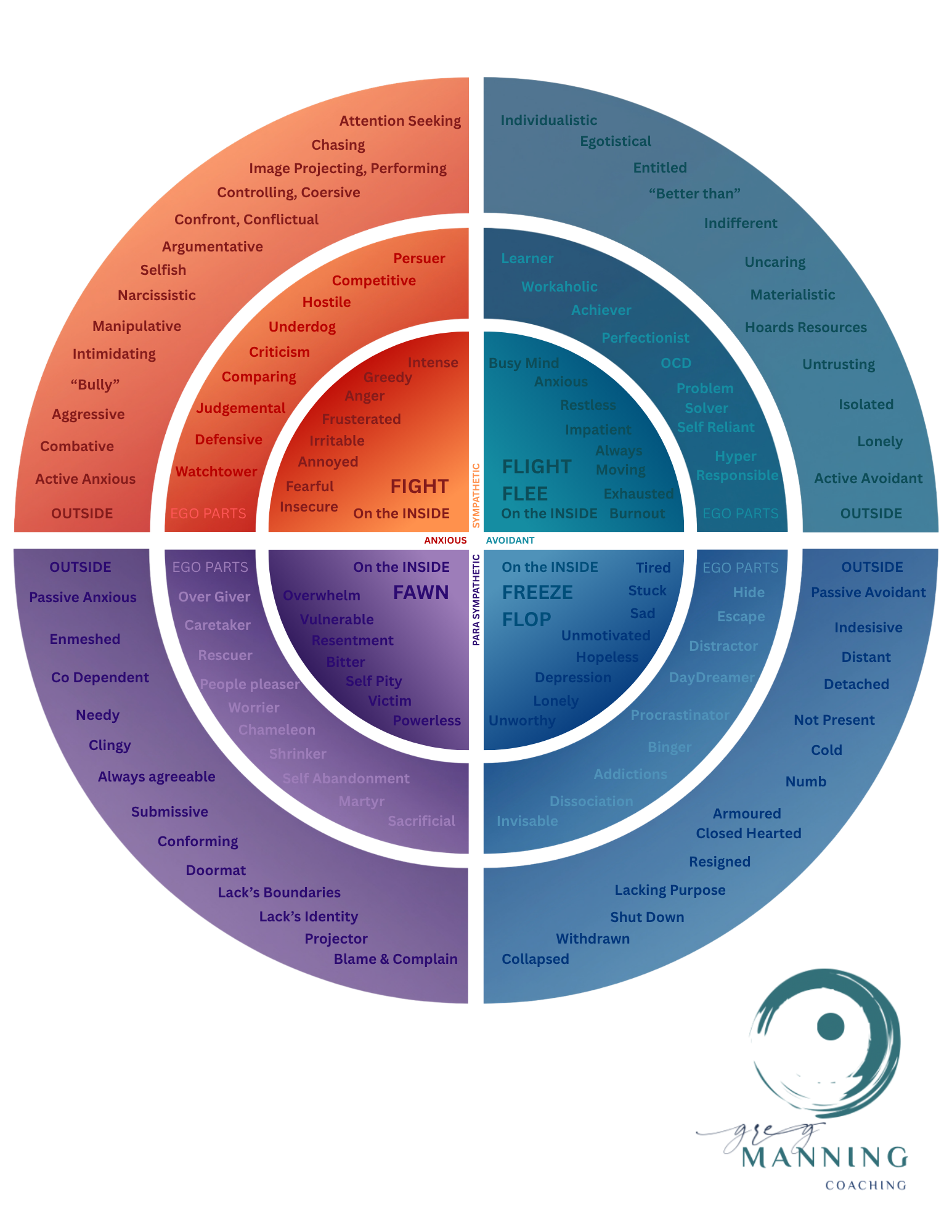
Meeting Stress in Human Behaviour through the 4 F's of Fear/Stress Response
FIGHT / FLIGHT / FAWN / FREEZE RESPONSES
I have found the simplicity of exploring our healthy and unhealthy coping strategies through the simple framework of the 4 f's of our Fear/Stress Response, to be as comprehensive as any other model, I have come across to date.
It is not meant to be a prescriptive map of your personal experiences. It likely won't fit for each unique individual in how emotions, feelings, and "parts" show up in you. Rather it can be used as a lightly held invitation to explore a list of common experiences that you can notice if any of them resonate within you.

THE FIGHT RESPONSE
When healthy, the fight response can allow for assertion and solid boundaries. It mobilizes us to be activated, readily engaged and empowered to meet the perceived potential stressor /pain at hand.
When unhealthy or when used as a trauma response, it's an over active self-preservation function where you react with unconcious anger and aggression. It's a fear state where you confront & combat the threat to stand up and assert yourself.
A fight trauma response is when we believe that if we are able to maintain power/hostility over the threat, we will re gain control.
This can look like choosing confrontation and conflict through arguments. Negative judgements, outward criticism, and emotional abuse. When escalated it can turn to yelling, throwing things, aggresion and physical fights.
Common FIGHT internal experiences include clenching of fists, tense muscles, racing heartbeat, profuse heat/sweating, extreme concentration, tight jaw, and overactive mind and stress due to always planning, controlling and managing.
An adult with unresolved FIGHT response can rely on being overly critical of others to boast up ones own feeling of adequacy, enoughness, and worth. Hyper competitive to prove oneself over another can be a self protective fight behaviour to maintain dominance and control. Defaulting to over defensiveness in discussions is a common fight tactic to combat their insecurities. Passive aggressivenes, and silent treatment are quieter ways of leveraging the fight response to maintain a felt sense of control.
The prolonged reliance on the fight response compound into over active sympathetic stress response. Chronic states of stress can lead to anxiety, insomnia, weight imbalances, and contribute to long term illnesses of cardiovascular health, and heart disease.

THE FLIGHT / FLEE RESPONSE
When faced with a dangerous situation, the FLIGHT response corresponds with avoidant behaviour.
When we’re balanced, we are able to be discerning in stressful situations through disengaging within limits. Creating space and healthy boundaries when needed.
However, as a trauma response, we take it a step further by isolating ourself entirely.
The flight response is when we believe that if we are able to escape the threat and avoid conflict, then we will not be harmed.
This can look like running away and avoiding conflict, pressure, and uncomfortable social interactions with others.
Alternatively, to avoid confronting unpleasant feelings, you may escape the situation by staying busy, distracting, numbing/self soothing through addictions, or self sabatoging when things start feeling to good to be true.

Common FLIGHT / FLEE internal experiences include feeling disconnected, emotionally numb, shallow, experiences of loneliness, feeling isolated and alone. Addictive behaviours can be self destructive and contribute to feelings of negative self judgement, self guilt, and internalized shame.
An adult with unresolved FLIGHT / FLEE response often form these behaviours early on in childhood as avoidant attachment styles. It can contribute to over independence, difficulty trusting others and building depth and intimacy in relationships.
Over time this can lead to one craving connection, but feeling emotionally unsafe in doing so. Needing help/support but untrusting and unwilling to ask for help. It can feel exhausting, like you have to carry the weight of the world, and always go at it alone.

THE FAWN RESPONSE
When balanced FAWN response is pro social behaviour, helping us collaborate and work together to achieve goals, and projects.
In it's imbalanced state the fawn response is about people-pleasing, and prioritizing other people above yourself. Bending to the needs of others to diffuse conflict and receive their approval, in turn experiencing a felt sense of safety.
It can reach a point where you abandon yourself, your needs, and healthy personal boundaries.
Care taking can be a positive quality, but when done with the hidden intention to appease others to avoid negative consequences, it can be costly to ones own healthy expression of self, and wellbeing.

Common FAWN internal experiences include feelings of overwork, exhaustion, lack of feeling seen, self betrayal, letting oneself down, inauthenticity, suffocated sense of autonomy, thoughts and feelings of negative self judgement, self guilt, and shame.
An adult with an unresolved FAWN response can become the root of co dependency. Individuals who experienced past trauma or neglect, may have resorted to a learned anxious attachment style, fawning as a way to seek reassurance, and maintain connection with their attachment figures. Prioritizing the needs of others to ensure safety and approval.
Because fawners experience a sense of safety and control even if it means tolerating exploitation, they are likely to stay in unhealthy relationship dynamics. (Trauma re enactment or trauma bonding).
Under expressed individuality, lack of assertiveness, and over agreeableness have significant correlations to depression, autoimmune conditions, and chronic illnesses such as ALS.

THE FREEZE / FLOP RESPONSE
When healthy, the FREEZE response can help you slow down and appraise the situation carefully to determine the next steps.
When unhealthy, the freeze response relates to immobilizing behaviours, a literal "freezing”, or feeling frozen and unable to move, in the face of a perceived extreme and life threatening danger.
We can compare this response to our animals who play dead in the presence of a predator.
A freeze trauma response is when parts of your sympathetic nervous system have reached a point of overwhelm causing a neurological shutdown.
A similar experience referred to as Dissociation may result. Finding yourself spacing out as if you're in a haze or detached from reality.
You don't feel like you're really there, mentally checked out as you leave what's happening in your surroundings and what you're feeling in an attempt to find emotional safety.
When we freeze, it might look like being at a loss for words, retreating into our mind, feeling disconnected from the present moment, and our bodies. Going emotionally or physically numb, and dissociating/spacing out, or even fainting.
It's the equivalent of temporary paralysis (unable to voluntarily move your muscles) while disconnecting with your body to prevent further stress.

Common FREEZE / FLOP / FAINT internal experiences include feeling incapable, whole body collapse, shut down. A feeling of giving up, powerlessness, and hopelessness.
This is common in instances of extreme burnout, and exhaustion, where we feel stuck or trapped in low energy states.
Numb, vacant, empty, withdrawn, resigned, disconnected, closed off, and cold, are all sensations that may be experienced.
An adult with unresolved FREEZE / FLOP response can get stuck in prolonged negative and heavy states of depression, low energy, tiredness, and lack of motivation.
This contributes to disempowered inner voices, extreme self criticism, self shaming, self hatred, self defeatism.

Meeting Stress in Human Behaviour through Attachment Theory & A Relational Dynamics Grid
WHY ATTACHMENT THEORY?
Early relationships lay the foundation, and blueprint of core beliefs, that shape our mental map of how to be in relationship to ourselves, and the other (the world around us).
These beliefs, and belief systems or mindsets, become an internal working model of social relationships and how we choose to navigate them in times of distress.
Attachment theory has since become the dominant approach to understanding early social development.
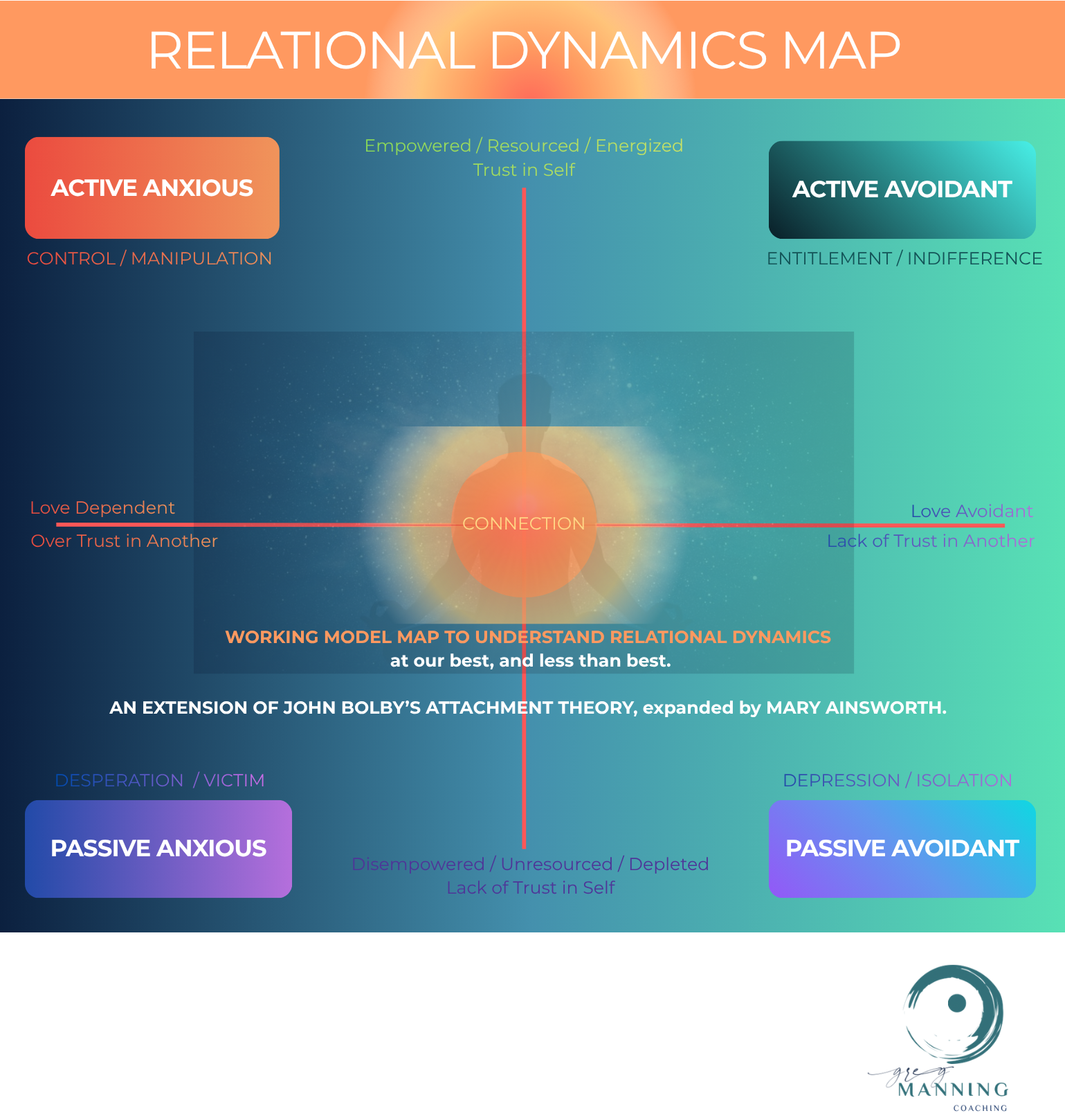
I created this grid for my own deepening of understanding, as a variation, and extension of John Bolby and Mary Ainsworth's clinical research on attachment styles and how early childhood attunement shapes, and influences our learned coping strategies in stressful situations later in life.
A 4 Quandrant Map/Grid following the intersection of 2 Axis’s reflecting how safe it feels to be in relationship to ourselves, and how safe we have learned it is to be in relationship to another.
Y AXIS - Your current self view, perspective, belief structure, model (Evaluation, Self Esteem) you have built around your Self belief, inner trust, and safety within yourself;
intersecting with your
X AXIS - current others view, perspective, belief structure, model, evaluation you have built around the safety, trust of another (the world as a whole).
This Map can help highlight inner experiences, and trailheads to unique ways our nervous system may have developed coping strategies in how we learned how to navigate the complex relational world around us.
It can show patterns of early developmental trauma attachment styles.
It speaks to common behavioural tendencies when it comes to relating.
Common Archetypes of Behavioural Coping
In human psychology, an archetype is a universally recognized theme, pattern, or tendency of behaviour. Archetypes can help serve as representations of common collective behaviour tendencies. While they will never be able to truely articulate the uniqueness of an individual, we can use them to bring awareness and deeper understanding of our common humanity in shared human behaviours, that can help us bring curiosity and awareness to similar "parts" of our personality that live within us.
These are not universal, prescriptive, or fixed qualities or traits. They are also not stereotypes of particular demographics. Instead they offer us insight into instinctual or common learned patterns of behaviour, that we use to keep ourselves safe. Behavioural Patterns show up in relational dynamics, family, and intimate connections. They are often brought into light in times of heightened stress, conflicts in communication, or when our nervous system feels unsettled, unsafe, or in perceived threat, risk, or danger.
In a Later Blog post, we will explore together some common "Parts", archetypes, and/or behavioural tendencies that may show up in various unique situations, and personal experiences.
When regulated, we have the capacity to choose to communicate effectively and work through a situation, other times we may find ourselves retreating into familiar defence mechanisms to feel better in the short term and avoid painful feelings.
While sometimes it is necessary for our unique situation, the impact of routinely employing our defences, can actually reduce the effectiveness of our emotional processing. We begin to feel as if we are not in charge of our own emotions, which prevents us from working through issues.
Working with our parts, helps us to become more cognizant of our personal tendencies so we don’t let your defence mechanisms overtake your progress in life.
CURIOSITY & COMPASSION
Finding our Center.

Highlighting these common coping strategies that arise when we are exposed to uncomfortable experiences, is not meant to further add to self judgement and internal guilt, or shame.
Rather from a place of curiosity and self compassion, inviting us to explore them as trailheads to begin to deepen our inward journey of self understanding. Only through the lens of loving awareness, can we meet these “parts” of ourselves, these “learned responses” from a place of heart space, humility and openness to listen what it is they are trying to teach us..
Somatic Shadow work is the most direct, compassionate, and sustainable healing access path to deepen our connection to Self, our innate truth, and the untapped potential hiding behind the stories of our self protective, yet often outdated strategies for navigating our world.
The practice of becoming aware of, making conscious choices, and gradual and sustainable changes to support the balance of our parts outdated strategies is called SELF REGULATION.
Which is going to be the core concept explored later in this series through how the practice of SURRENDER, can support sustainable Self Regulation and Stress Resilience.
Congratulations! You made it to the end of Week 5.
If you are curious to learn what is possible in deepening your connection with stressed or over protective parts and what they may be struggling with. I welcome and encourage you to Schedule a 1on1 Discovery Call. We can hear from your parts and explore together in what they may be wanting support in.
Join Me Next Week!
For Week 6 of the Series BEFRIENDING STRESS As a Path Home to Ourselves.
Where we will explore the final segment to this Series.. Where do we go from here?! Practicing Surrender to shift from Distress into Eustress.
Friendly Reminder, to all of your parts, you are welcome in this space.
To greater awareness, self healing, and integration.
May your week be joy filled!
Greg